Now that the semester has come to a close and my life is squished into cardboard boxes, I thought I'd take a moment to reflect on the last set of adventures before embarking on a new one.
It's been a very, very full semester of planning, planting, and cooking...in the best way possible, of course. I sprayed aphids until they filled my dreams. I filled my fridge with sauerkraut. I ate probably way too many beets. And I'm so glad that I did.
A student's life isn't easy, and it's not always fun. But I can honestly say that my memories with the Eco Wing girls has been some of the best from this year. Knowing that somebody--multiple somebodies!--on campus cared about my passions, even if they seemed a little weird or gross to others, was such a comfort. Having adventures and making food was a fantastic way to relieve stress. Most importantly, I am so happy that I've had the chance to be part of this community in a new way and really connect to these girls--my classmates, my neighbors, my friends. I think that our scheming and creating this semester has prepared me not only for my work with Environmental Department next year but also for becoming the kind of person that I want to be for the rest of my life.
I'd like to express my hope that we keep updating each other and making records here of our ideas, realizations, projects and experiments. I'd like to wish next year's Eco Wings the best of luck. I hope you are inventive and silly, and I hope you make messes. I hope you come to us when you need us, and I hope you do things we never even thought of.
Cheers to a great year, and cheers to whatever comes next!
And send many tomatoes.
xoxoxo
Yona
Saturday, May 25, 2013

Tuesday, May 14, 2013
Cleaning!
After my roommate and I returned from study abroad, the
subject came up of buying new cleaning products for the bathroom. I said no.

I wanted to try cleaning the bathroom with all natural products. This is not only safer for me and my roommate, who do the cleaning and use the bathroom, but also reduces the amount of chemicals going down the drain and contaminating water. I’d heard about cleaning with vinegar and baking soda, so I set about teaching myself to do so.

There are so many how-to’s and videos about how to clean your bathroom with natural products that it was kind of overwhelming. I realized I had to develop my own system that works for me. I improvised and came up with this process. It works for me but may not work for you, so practice and tailor it to your own needs/ means.
I wanted to try cleaning the bathroom with all natural products. This is not only safer for me and my roommate, who do the cleaning and use the bathroom, but also reduces the amount of chemicals going down the drain and contaminating water. I’d heard about cleaning with vinegar and baking soda, so I set about teaching myself to do so.

There are so many how-to’s and videos about how to clean your bathroom with natural products that it was kind of overwhelming. I realized I had to develop my own system that works for me. I improvised and came up with this process. It works for me but may not work for you, so practice and tailor it to your own needs/ means.
The tools:
Sponge- I used a regular green and yellow one, the “natural”
ones from specialty stores are quite expensive
Plain white vinegar- Vinegar is the agent that
kills germs. It is not as strong as other synthetic cleaning products, but it
is less toxic because it breaks down easily. Use diluted with water (1:1)
Baking soda- Acts as a deodorizer and abrasive
Towels
Old shirt (leaves less lint on the mirror)
Old toothbrush for scrubbing grout

The process:
For cleaning the sink, bathtub, and toilet I used pretty much
the same process. I squirted the vinegar mixture on the surface, or poured it on the
sponge, or dipped the sponge in a cup of it. I then used elbow grease to scrub
the surface.
For tougher areas (TUB) I sprinkled baking soda on top and
scrubbed.
 |
| elbow grease!!! |
For scrubbing the tile/grout in the shower, I mixed the baking soda
and vinegar so that they would foam/bubble.
For the bowl of the toilet I poured
vinegar around the top of the bowl, then shook some baking powder into the
water. I used a toilet brush to mix it so it would foam and then waited a few
minutes before scrubbing it like usual. For the mirror, since I don’t have a
spray bottle, I poured vinegar on the shirt and used it to wipe the mirror and dried with a dry side of the shirt.
 |
| Sqeaky clean! |
My thoughts:
-
Vinegar is made from corn, which is often farmed usnsustainably.
-
These products don’t smell or foam so it doesn’t feel like
my old idea of “clean”. Just a cultural thing I need to let go of. (Well, the
vinegar does smell, but it goes away very quickly).
-
Because they are not toxic chemicals, there’s no real
need to rinse. I just wipe off with a towel and save water. :)
-
I think it is much cheaper to use, haven’t done
the calculations though
-
Because it doesn’t smell and they aren’t
chemicals and they are cheap, I tend not to be careful with the amount I use: I
probably waste a lot of vinegar and baking soda.
-
I don’t need to use gloves or feel bad for
inhaling fumes.
 |
| look at that cutie ;) |
Now to figure out cleaning the tile floor….
Would you ever clean
your bathroom with just baking soda and vinegar?
Tuesday, April 30, 2013
The Ecology Center Field Trip
Beautiful. Clean. Crisp. Healthy. Natural. Raw. Cozy. SoCal. Sustainable.
What More Could You Ask For?
The Ecology Center, San Juan Capistrano.


What Crafty Skills Have You Got Up Your Sleeve?
There is nothing like throwing some blankets on the grass, listening to Sarah & Ashlyn on the uke, basking in the sun, and learning some fun crafty activities from your friends. Regardless of how many people showed up, I surely learned some awesome (possibly life-saving) skills at our little Skills Exchange Party! Yona shared how to make beads with magazines, Lizzy blessed us with her handy-dandy knowledge of how to make a basket with pine needles, and Ashlyn taught us how to give an epic massage! If I'm ever stuck in the woods, at least I'll be able to hold the beads I made in the pine needle basket, while giving myself a massage.


Monday, April 29, 2013

Eco Wing Visits the Ecology Center
All semester long, I’ve felt a little like Sherlock Holmes investing a
crime scene: the case of the missing pro-environmental attitude. (Or
something.) So many of the people we’ve run across have mentioned or taken part
in the Ecology Center—all of our clues lead us that way. So, finally, after a
great deal of scheduling and re-scheduling, the eco wing girls and I took a
tour of the Ecology Center at San Juan Capistrano today. So, here's my take on what we learned today, and perhaps the other girls will want to share some of their thoughts in a post as well.
The Ecology Center, now
in its fifth year of operations, is an old farmhouse (Victorian details) surrounded
on three sides by an unaffiliated farm. The front yard is not a lawn but
instead native plants, succulents, and other drought-resistant plants.

Inside the house is a
small gift shop, but the center’s main focus is children’s education and
workshops. Around the site they have multiple displays and interactive
activities (scavenger hunts, workshops) under the themes of water, food, waste
management, shelter, and energy. For example, they have a traveling
watershed-mobile, which is a trailer (painted with whales and water) that opens
up to an interactive game where children choose how to spend their “water
allowance” and see the effects their choices make. Sarah and I want to invite
the watershed-mobile on campus for International Festival next year through
Environmental Department.

Overall, I think my
favorite thing about the Ecology Center was the crisp, simple design of all the
art and layouts. They were iconic, replicable, and easy to spot in the foliage.
The pretty, thoughtful design made me want to be there and made me want to try
making my own… everything!
The day after graduation,
the Ecology Center is hosting a beekeeping workshop, and I am determined to go.
I’ve tried twice this semester to go to two other beekeeping workshops, but
have been thwarted by bad weather or lack of a car. Maybe the third attempt
will be the charm!
 |
| Blue bins for recyclables - color coding + examples |
 |
| A rainwater catchment cistern |
 |
| The inside of the greenhouse - designed like a beehive to use the least amount of materials and remain strong |
 |
| A sink that helps monitor water usage |
Tuesday, April 16, 2013
A Quick Video How-To for Tire Pounding
Youtube is full of information on Earthships. If you want, you can start with a 2 minute-long video of a tire pounding workshop this weekend at Barndstall Art Park in Hollywood, made by yours truly.
You can also check out the man behind the earthships, Mike Reynolds, in this full-length movie about him, his earthships, and his attempt to change New Mexico law to allow experimental building.
When we applied for the grant, we promised we'd present what we learned to the campus...so we'll be putting together a lot of information about earthships in the coming weeks, which we'll start posting here when we can.
You can also check out the man behind the earthships, Mike Reynolds, in this full-length movie about him, his earthships, and his attempt to change New Mexico law to allow experimental building.
When we applied for the grant, we promised we'd present what we learned to the campus...so we'll be putting together a lot of information about earthships in the coming weeks, which we'll start posting here when we can.
Sunday, April 14, 2013
Earthship Biotecture Workshop More Info to Come...
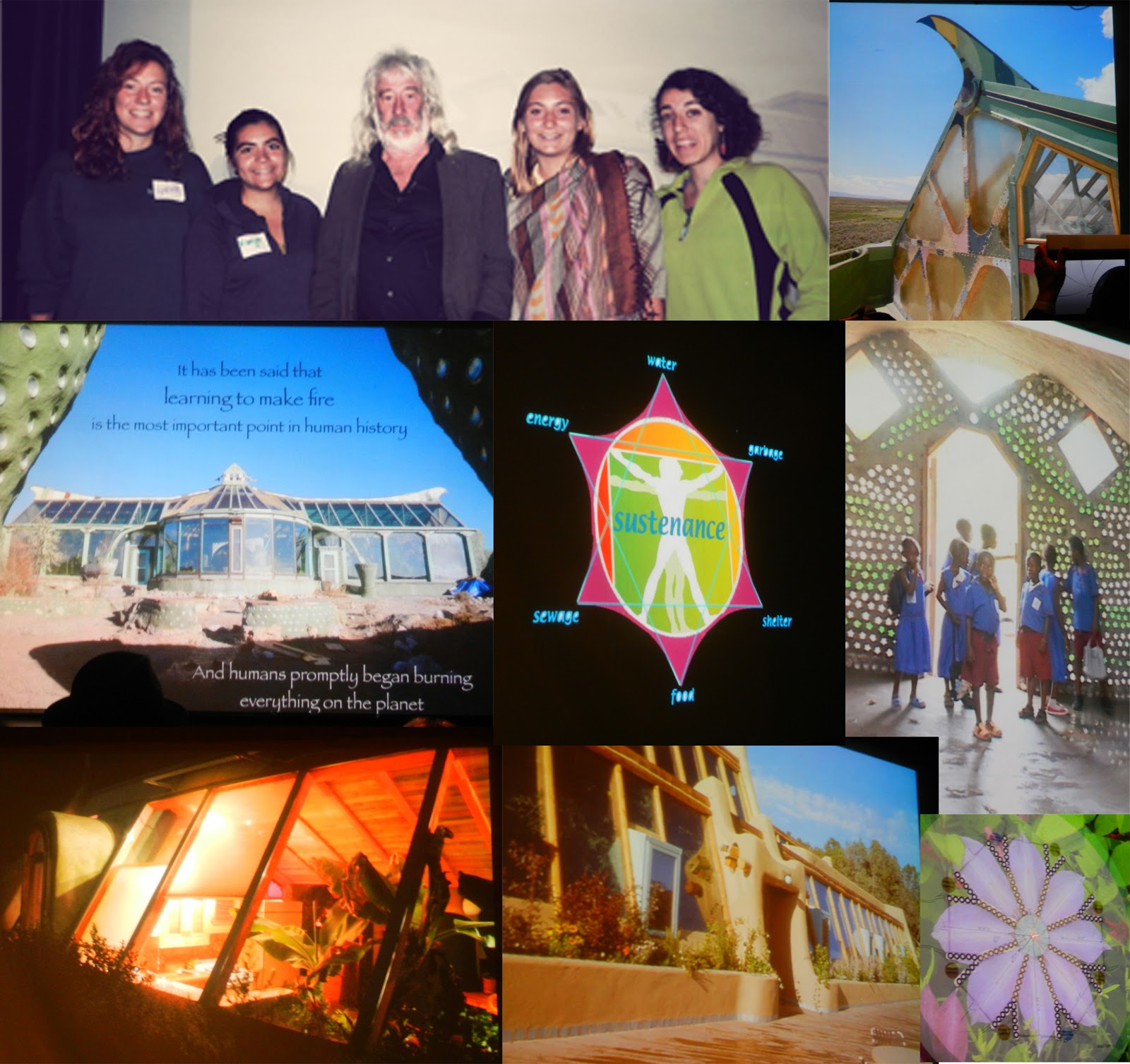
We are all filled with SO much information and inspiration after the Earthship Workshop.
More info to come!
Friday, April 12, 2013
Let Food Be Thy Medicine
There is nothing like a homemade meal- that you cooked, from your backyard! Our lovely Soka Instructional Garden gave birth to this lovely meal today. Labor was done by Yona, Ranya, and Leia. A big thanks to Julian and Ale for opening their kitchen for us to cook in!
Organic Vegan Soup: onion, fava beans, kale, swiss chard, beets, broccoli, cabbage, garlic, and fresh herbs (everything from SIG minus onion and garlic)
Organic Vegan Salad: kale, swiss chard, cabbage, and kale flowers + lemon, olive oil, salt, and Bragg amino acids.
THIS IS THE REAL DEAL. FOOD IS MEDICINE.

Tuesday, April 9, 2013
Earthship documentary...excited for the workshop!
So excited for our earthship building workshop this weekend! (Read about how we got a grant to attend here). It will be led by Mike Reynolds (!!!), the man who developed the idea of earthships and stars in this documentary:
I think the first day of the conference will be a screening of this movie, but for any of our friends who want to see what we're going to learn about check it out! Or visit the website at http://earthship.com/.
I think the first day of the conference will be a screening of this movie, but for any of our friends who want to see what we're going to learn about check it out! Or visit the website at http://earthship.com/.
Sunday, April 7, 2013
Sauerkraut Taste Testing: An Adventure in Bathroom Chemistry
Feeling okay so far! We put some of it in our fridge so we can eat it cold later. (After we determine for sure whether we did it right and we should be eating it... We're going to show it to our raw food savvy friend and ask what she thinks.)
Maybe we'll try some version of these variations!
Thursday, March 28, 2013

Wednesday, March 27, 2013
Meeting Minutes 3/27/13
Present: Leia,
Ranya, Yona, Seika, Wanna and Sarah
Updates:
Overview
of GCI
To do: Meet-up with lady from GCI
Movie
screening last night on Story of Stuff
Posters
about Ecowing
Logo: Yona
came up with idea: boot with plant (like Wall-e) don’t want to out eco-wing in
case it changes
t-shirts, to-go mugs?
:D
use in presentation on housing meeting if possible
Next week's events:
San Juan
Capistrano Ecology Center field trip:
April 1st leave at 2:15 and arrive 2:45
Housing
meeting Tues 4/2:
Show blog, maybe make video
Advertising on screens
Check with Michelle about having a senior floor, or in the
mixed hall!!! plan to have it again in this hall?, keep for juniors and keep
current members as mentors
--Meeting with Michelle possibly Friday @3
Soon:
Earthship
workshop: Fri 4/12 at 5pm to Sun 4/14 at 5pm
paid with Wanna's card
to be reimbursed
$200 left in ecowing funds, use 1/2 for grant ($100, so $25
each out of pocket)
56 cents mile reimbursement for car (Ranya drives)
Presentation day? Informal class? Pick date after
Presenting in at IF (earthship and ecowing)
Next next Sunday (4/7) movie night: documentary or Erin Brockovich
Next film screening April 18 at 7pm: The Island President
SUA Today articl: due April 11: include pics, talk about grant, etc.
SUA's website green living section: meet with Lisa Kawai during lunch next week
In the future:
Eco wing
skills exchange party
Earth day (April 22)? Talk to people, posters/flyers
Farmers
market informal field trip: Sundays (8-12) at Sprouts
Eco-wing
host with Bon Appétit kim chi making workshop
Don in
ceramics: making pots for garden or balcony plants: small ones are a go :) and big ones
maybe
Volunteering?
Movie
screening for May?
Labeling
plants around campus
Natural Products Expo West

Imagine the colors, sounds, and frantic energy at a Toys-R-Us, the massive health options of a Costco-style Whole Foods, and the amount of free samples at a farmers market. That describes the Natural Products Expo in a nutshell. On March 10th I had the privilege to attend the Natural Products Expo, the world’s largest and premier tradeshow dedicated to everything “natural” from household products, to food, to supplements, to clothing, to beauty products, to pet supplies. This expo, only opened to industry professionals (I have my ways), felt like a Disneyland for health foodies and I won’t deny it; I was feeling the thrill. Hopping from station to station, from free sample to free sample, I was exposed to all types of vegan, organic, raw, fermented, recycled, non-GMO, superfood, fair trade, rainforest alliance products. As a second year attendee, I noticed that this year the hot item was fermented goods, specifically sauerkraut and kim-chi. Not to mention the “usuals” that were last year’s “it” item, such as competing brands of coconut water, kombucha, and organic chocolates. As scientific discoveries explaining the health benefits of some new “must have” berry or seed emerge every few months, the old products that once had the spotlight get pushed aside. The health food industry is ultimately like any other industry with exceptional marketing strategies. I mean come on, who here wouldn’t be drawn to the latest brew packaged in a cool glass jar or a biodegradable rustic yet hipster looking package? Men, forget about walking around with a Chihuahua to attract the ladies; the new lady magnet is that sexy bottle of kombucha and kale chips you be munching on after yoga class.
What I would have like to see more of at the Natural Products Expo is an emphasis on local goods. After exposing myself to all sorts of fun, innovative, and healthy items from around the globe, I slowed down and took a step back. I remembered the garden I have at Soka and the feeling I get after eating straight out of the soil. A local garden is health and that is where I can get all the essential nutrients and energy my body needs. All the other drinks, supplements, and products laced and embedded with vitamins and minerals are good too, but surely not vital to my basic overall health. How long ago was the packaged food picked- or in other words, how long has it been dead? I don’t mean to be a localvoire Nazi who believes everything we eat, wear, and use should come from the same street we live on ( I mean, that would be pretty cool...). Like I said, I love my foreign superfoods so like any other health conscious person I would not want to see them completely go. What would be ideal was if marketing for these kinds of goods shifted. Instead of organic companies proudly promoting the fact that their product comes from the remote Amazon jungle or the Himalaya Mountains, and the consumer seeing that as “cool” and “it must be healthy,” what if we can shift that mentality to seeing those products as a rare, very rare delicacy; something that is only available in season and on special occasions. What if we respected the procedure it took for the product to get to us, rather than thinking “this goji berry coconut chia seed raw chocolate spirulina smoothie will give me the nutritional boost and energy I need before my morning workout!” The health food movement, with myself included, has become so focused on the health aspect that we have neglected all of the other layers of the food production cycle. Furthermore, we have become completely oblivious to what I consider to be the most important contributor to our health; our very own backyard/community gardens.

Monday, March 25, 2013
A Thought on High Heels
A few weeks ago, I went shopping with Ranya and her sister Manal. As we were walking to
Manal’s car, I was very aware of the sound of my heels striking the pavement.
“Hee hee, I like wearing high heels.”
Ranya asked why (I don’t think
I’ve ever seen her willingly wear high heels), and I said that I feel
confident in them, partly because they make me taller and partly because I like
the noise they make when I walk.
By the time we made it
to the store, I’d had some time to reflect and let the conversation soak in…and
it occurred to me that high heels are only appropriate and reasonable in an
environment with many paved surfaces. You don’t wear heels when you know you’re
going to walk through a lot of grass or mud because a) it’s going to ruin the
shoe and b) you won’t be able to walk effectively anyway because the heel will
keep sinking into the soft surface. In that way, my shoe choice is linked to
things like the heat island effect and human separation from nature! (Not to
mention the ways that they probably perpetuate sexist principles…but that’s not
my area of expertise, and it’s off-topic, so forget it.) I’m probably not going
to stop wearing those types of shoes anytime soon, but I definitely did change
the way that I think about them.
The Celestial Seasonings Tea Factory Tour
(Alt Title: The Proof That Any Innocent Activity can Become a Political Act)
(Alternate Alt Title: I Got Class Credit for This, and I was Excited to do my Homework)

I spent the first half of my spring break with Amanda in the
Boulder, Colorado area, home of the Celestial Seasonings tea factory. Since Amanda and I are both avid tea-drinkers, we decided to swing by to take the
factory tour. Not only did we get some free samples, but I also found the
experience to be an eye opening one.
To the average consumer, Celestial Seasonings looks like
an eco-conscious dream. Tea is sampled in reusable ceramic cups, not disposable
paper or plastic. In the gift shop, you can find notebooks made of recycled
paper and “all natural” soaps, lip balms, and other beauty products. The tea
bags themselves are chlorine free and compostable. Celestial Seasonings uses
many USDA organic-certified ingredients. They contribute to various causes,
such as Trees for the Future. And of course they recycle—but should we say downcycle?
I’m glad that Celestial Seasonings makes use of those
practices at the very least—they’re doing what I think should be the minimum
industrial standard—but I still have some concerns. First of all, although I
appreciate that the company values farmer relations and the use of organic,
GMO-free products… they’re not certified organic or fair trade.
Even if the tea was fair trade certified, I’d still be
concerned just because tea is a cash crop. Particularly in countries like
Guatemala (the Celestial Seasonings lemongrass provider) that have high rates
of malnutrition, I think tea is the last thing they should be growing. “Fair
pay” does not guarantee that those people can afford to buy the actually edible
foods that must be imported. By “those people” I do not mean the individual
farmers necessarily but the entire country. When more people make their pay
from cash crops, it means more foods have to imported, which means more people
across the nation will have trouble paying for quality food.
Moreover, the lack of a fair trade or organic makes
certification me unable to fully trust the company’s claims about close ties
with local Guatemalan farmers and GMO-free products. As the biggest tea
distributor in America, surely they can afford the fee to become certified. So,
something else is obviously disqualifying them. I find that troubling because
we already saw in Learning Cluster how the organic label has already been
“watered down” so much.
The organic thing isn’t actually that big of a deal,
though. The bigger problem is also one of Celestial Seasoning’s greatest
sources of pride: the ingredients for their tea come from thirty-five different
countries all around the world. I guess that’s neat, except for the amount of
fossil fuels that are expended on ingredient shipment alone, forget the fossil
fuels that go into the machines in the factory and then shipping the finished
product all over the world. As long as that’s still true, no amount of
recycling is going to leave Celestial Seasonings with a positive ecological
impact, or even a neutral one.
On a human level, the factory looks like as unpleasant
and unfriendly a place to work as any other manufacturing plant. The lights are
harsh, the machines are noisy, and the workers do the same repetitive tasks
over and over. It didn’t have to be designed that way.
Perhaps most frustrating of all is that the people who
worked there genuinely seemed to believe that they were making the world a
better place.
My tour of the factory did have a positive outcome, if
only in that it made me want to find other sources for my tea. I want to learn
how to make my own herbal teas from plants that I can grow in my own garden. To
start, we’ve got a chocolate mint plant growing in the SIG right now. I’m also
okay with buying locally grown and produced teas. But no more Guatemalan
lemongrass, please. That also means that I can’t be drinking Argentine mate all day every day. I think it’s
probably alright as long as it’s an occasional thing only.
Composting and a Pep Talk
Pep Talk
I'm sure I'm not the only one who was bummed out by the recent blow-out over the Green City Initiative... so here's a thought to cheer us all up:
Yes, unfortunately, there are always going to be at least a few jerks in the world who are willfully ignorant and disrespectful...but there are also always going to be passionate, compassionate people out there striving to think outside the box and make this world a better place. Ultimately, all we can do is keep doing our best to be the second type of person and hang in there.
I'm proud of all of us.
That said, life goes on. And so I'd like to talk to all of you in internet-land about some of the (bacterial) life happening in our dorm room....
Composting
In case anyone doesn't know, compost is decomposed organic matter that can be used in the garden to give plants a nitrogen boost. Composting is great not only for the garden but also for a) physical well being (shoveling and turning piles of decomposing matter is a workout and it gets you outdoors!) and b) reduces the amount of waste going to landfill. Why throw it away when you can still put it to good use?
Soka will soon be sending all of its cafeteria wastes to a composting facility. However, Ranya and I have already gotten a jump start on that in our dorm room.
 We bought this metal tin at Good Will for $3, and we use it to compost the food wastes we generate in our own rooms. Each Sunday when we work in the garden, we bring our goodies to the garden to add to our compost piles or the vermiculture bin.
What we compost:
Tea bags (staples removed)
Yerba mate
I'm sure I'm not the only one who was bummed out by the recent blow-out over the Green City Initiative... so here's a thought to cheer us all up:
Yes, unfortunately, there are always going to be at least a few jerks in the world who are willfully ignorant and disrespectful...but there are also always going to be passionate, compassionate people out there striving to think outside the box and make this world a better place. Ultimately, all we can do is keep doing our best to be the second type of person and hang in there.
I'm proud of all of us.
That said, life goes on. And so I'd like to talk to all of you in internet-land about some of the (bacterial) life happening in our dorm room....
Composting
In case anyone doesn't know, compost is decomposed organic matter that can be used in the garden to give plants a nitrogen boost. Composting is great not only for the garden but also for a) physical well being (shoveling and turning piles of decomposing matter is a workout and it gets you outdoors!) and b) reduces the amount of waste going to landfill. Why throw it away when you can still put it to good use?
Soka will soon be sending all of its cafeteria wastes to a composting facility. However, Ranya and I have already gotten a jump start on that in our dorm room.
 We bought this metal tin at Good Will for $3, and we use it to compost the food wastes we generate in our own rooms. Each Sunday when we work in the garden, we bring our goodies to the garden to add to our compost piles or the vermiculture bin.
What we compost:
Tea bags (staples removed)
Yerba mate
Apple cores
Orange peels
Banana peels
Paper towels
Personally, it makes me feel better to know I'm wasting a little bit less, and I can put it to direct use in the garden. We grow bigger plants, eat, and then compost the wastes again!
And, no, it doesn't stink because there's a lid on it and we empty it out regularly.
And, no, it doesn't stink because there's a lid on it and we empty it out regularly.
The gift that keeps on giving!
Sunday, March 24, 2013
Green City Initiative Update
I thought I would provide an update
of what happened with the initiative Leia posted about here.
Wednesday night the
city council of Aliso Viejo addressed the proposed Green City Initiative.
Information on it can be found here.
Some Soka students, including Ecowing
members (Sarah and myself), attended the meeting and some spoke publicly to the
council expressing the students’ support of the initiative. The night lasted three and a half hours (!!!) and got quite heated with many community members expressing concerns
over the costs and other issues with the initiative and others expressing deep
belief in the initiative. Ultimately the council decided to postpone voting on
the initiative, asking the staff to provide further information before they
decided on it. The date was not set but we’ll let everyone know when we know.
 |
| City Hall was packed! |
Personally, I was quite upset at
some of the comments that were made. Many questioned the existence of climate
change, questioned the education we receive at Soka, focused on the immediate
costs of the initiative without considering the long term benefits or benefits
to future generations, implied a conspiracy theory is behind the GCI, etc. Some
members of the crowd were very intolerant (and quite frankly rude) and did not
seem to be open to any new ideas that were presented. But I think it’s also
important to recognize that some that oppose the initiative have very real and
reasonable concerns about how their businesses will be affected and where the money
for writing and implementing the initiative will come from. There were also
many voices that spoke in support of the GCI, such as the Sierra Club, high
school and Soka students, and residents. A review of the event can be found here.
Despite the surprising divisiveness
of the issue, I think there is an important lesson we can take away from the city
hall meeting: participating in government, especially local government, is a
wonderful and important way to living sustainably. People feel empowered by participation and are more
likely to take on leadership roles in the community. The fact that this
conversation was allowed to happen and that (most) voices were heard shows that
citizens can help shape their lives and can help create a more sustainable life
in their community. I am very proud of our participation in the event.
Some ideas for discussing:
-What do you think about the Initiative?
-What do you think about the Initiative?
-One resident expressed the idea that the initiative is
merely an example of great city planning and just the name “green” makes it
scary to some and draws criticism. Do you think the name plays a big role? Is “green”
overused? Does it come with a positive/negative connotation?
- How important is participating in the community?
Recommended Read: The Heirloom Life Gardener


Living sustainably means eating sustainably.
Here is a great book for gardening with heirlooms.
The Heirloom Life Gardener.
Subscribe to:
Posts (Atom)